
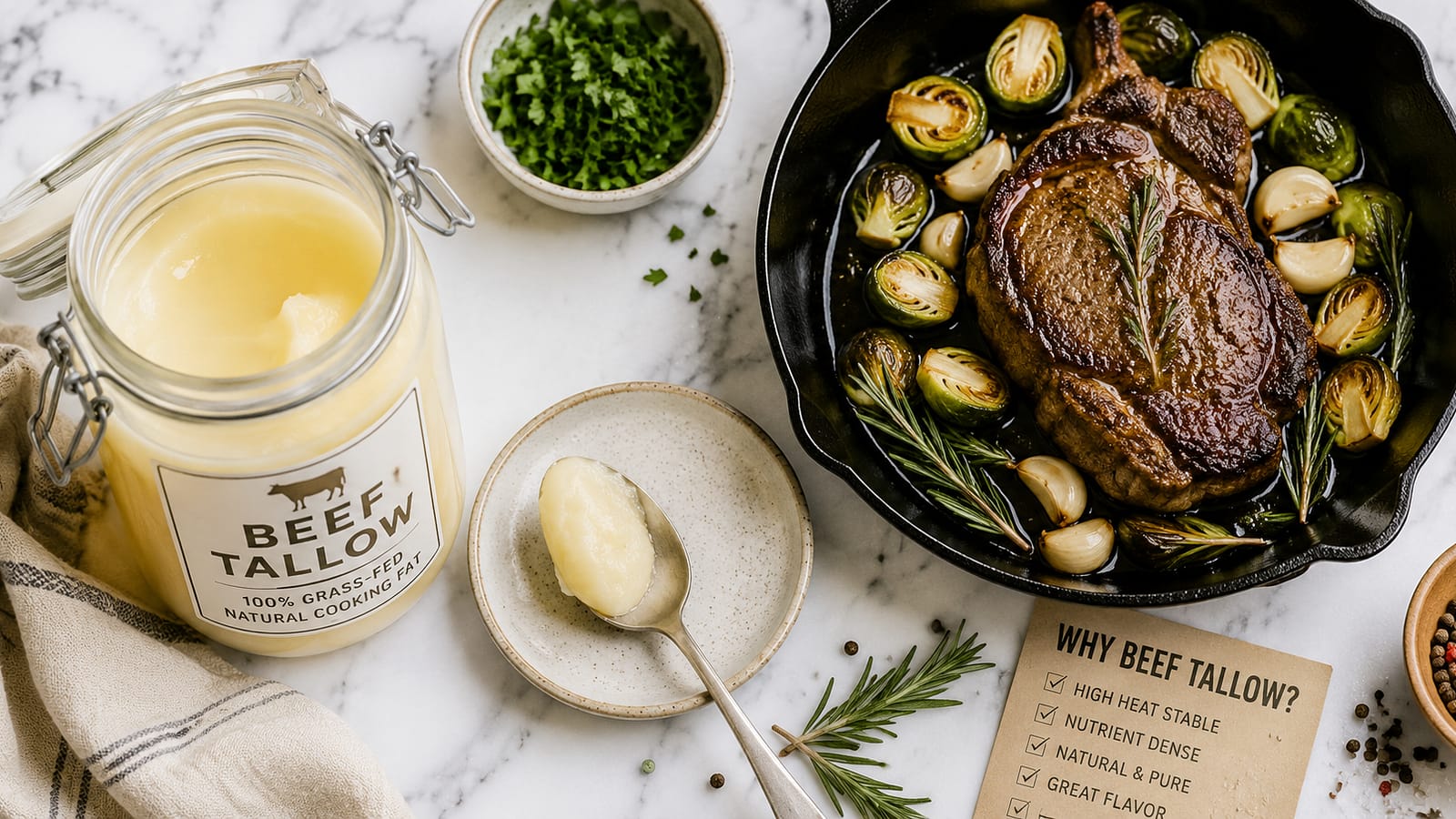
Something interesting is happening in American kitchens in 2026. People are opening their cabinets, looking at their vegetable oil, and throwing it in the trash. In its place? A humble jar of rendered beef fat that their great-grandmothers used for everything.
Cooking with beef tallow is one of the biggest food trends of 2026 — driven by growing skepticism of seed oils and renewed appreciation for traditional animal fats. McDonald’s used to fry their famous french fries in tallow before switching to vegetable oil in 1990. Many argue they’ve never tasted as good since.
This guide covers everything you need to know about cooking with beef tallow: what it is, why people are switching, how to render it at home, and the best recipes to make with it.
What Is Beef Tallow?
Beef tallow is rendered (melted and purified) beef fat — typically from suet, the hard fat surrounding the kidneys. Cooking with beef tallow has a history spanning centuries: it was the primary cooking fat in American kitchens before the vegetable oil industry marketing campaigns of the 20th century convinced consumers that animal fats were unhealthy.
According to Hitchcock Farms’ 2026 food trends analysis, beef tallow is making a major comeback — driven by consumers seeking natural, whole-food alternatives to processed seed oils. Cooking with beef tallow is now endorsed by health-conscious home cooks, carnivore diet advocates, and traditional food enthusiasts alike.
10 Reasons to Start Cooking with Beef Tallow
1. Incredibly High Smoke Point
Cooking with beef tallow gives you a smoke point of approximately 400°F (205°C) — higher than butter, comparable to refined coconut oil, and significantly more stable than many seed oils that oxidize at high temperatures. This makes tallow ideal for frying, searing, and roasting.
2. Outstanding Flavor
This is the #1 reason people start cooking with beef tallow and never look back. Tallow imparts a rich, savory, beefy depth to everything it touches. French fries cooked in tallow taste dramatically better than those cooked in vegetable oil — and McDonald’s original recipe proved this to an entire generation of Americans.
3. More Stable at High Temperatures
Seed oils (canola, soybean, corn oil) are high in polyunsaturated fats that oxidize rapidly at high temperatures, potentially producing harmful compounds. Cooking with beef tallow — which is high in saturated and monounsaturated fats — is significantly more stable at cooking temperatures.
4. Nose-to-Tail Sustainability
One of the sustainability arguments for cooking with beef tallow: it uses fat that would otherwise be discarded or rendered into low-value products. Using tallow makes use of the entire animal — reducing waste and maximizing the value of beef production.
5. Long Shelf Life
Properly rendered tallow lasts months at room temperature and up to a year in the refrigerator. Cooking with beef tallow gives you a shelf-stable cooking fat that doesn’t go rancid nearly as quickly as most seed oils.
6. Natural, Whole-Food Fat
Cooking with beef tallow means using a fat with one ingredient: beef fat. Compare this to industrial seed oils, which typically require chemical extraction, bleaching, and deodorizing before they reach your bottle.
7. Rich in Fat-Soluble Vitamins
Grass-fed beef tallow contains fat-soluble vitamins A, D, E, and K2 — nutrients that are genuinely beneficial and that your body requires fat to absorb. Cooking with beef tallow from grass-fed sources adds these micronutrients to your diet.
8. Perfect for Cast Iron
Cooking with beef tallow is ideal for cast iron seasoning — the high saturated fat content creates a durable, non-stick coating that polymerizes beautifully onto cast iron surfaces. Many cast iron enthusiasts consider tallow the best fat for maintaining their pans.
9. Incredibly Crispy Results
The fat composition of tallow produces the crispiest fried and roasted foods imaginable. Potatoes roasted in tallow develop a shattering crust. Chicken fried in tallow has an incomparable crunch. Cooking with beef tallow produces texture results that vegetable oils simply can’t match.
10. Traditional and Time-Tested
Cooking with beef tallow connects you to generations of cooks who built their food traditions around this fat. Before the seed oil era, tallow was in every American kitchen. Its return represents a broader trend toward traditional, whole-food cooking philosophies.
How to Render Beef Tallow at Home
You can make your own cooking with beef tallow supply at home from raw suet purchased from your butcher (often free or very cheap):
Slow Cooker Method (Easiest):
- Cut beef suet into small pieces or pulse in a food processor
- Place in slow cooker on LOW
- Cook 4–6 hours until fat is fully melted and light brown bits remain
- Strain through cheesecloth into glass jars
- Allow to cool — tallow will turn white and solid
- Store at room temperature for 3 months or refrigerate for up to 1 year
Stovetop Method (Faster):
- Place suet in a heavy pot over very low heat
- Cook 2–3 hours, stirring occasionally, until all fat is rendered
- Strain and store as above
Best Recipes for Cooking with Beef Tallow
Cooking with beef tallow works for virtually anything you’d use other fats for:
- French Fries: The classic tallow application — crispiest fries you’ve ever tasted. See how we approach our copycat fast food recipes for technique
- Roasted Potatoes: Toss potatoes in melted tallow before roasting at 425°F — the crust is extraordinary
- Fried Chicken: The original American fried chicken fat — produces incomparable crunch
- Seared Steak: The flavor combination of beef cooked in beef fat is deeply satisfying
- Roasted Vegetables: Toss any vegetable in tallow before roasting for incredible caramelization
- Eggs: Frying eggs in tallow adds a subtle savory depth that butter can’t replicate
- Pie Crusts: Traditional pastry was made with lard and tallow — the flakiest, most flavorful crusts use animal fat
Cooking with Beef Tallow vs Seed Oils
| | Beef Tallow | Vegetable/Seed Oil |
|—|—|—|
| Smoke point | ~400°F | Varies (often 400-450°F but unstable) |
| Fat stability | High | Lower (oxidizes easily) |
| Flavor | Rich, savory | Neutral |
| Processing | Minimal (render and strain) | Highly processed |
| Shelf life | 1+ year | 1–2 years (in sealed container) |
| Cost | Low (from butcher) | Low |
Frequently Asked Questions — Cooking with Beef Tallow
Is cooking with beef tallow healthy?
The health conversation around cooking with beef tallow is nuanced. Tallow is high in saturated fat, which has been controversial — but current research suggests the relationship between saturated fat and cardiovascular disease is more complex than previously thought. Tallow is also more stable at high temperatures than polyunsaturated seed oils. As with any fat, moderation is key.
Where can I buy beef tallow?
Your local butcher is the best source for raw suet to render yourself. Pre-rendered tallow is also available at Whole Foods, health food stores, and online. Brands like Fatworks and Epic produce high-quality, grass-fed cooking with beef tallow products.
Does beef tallow make everything taste like beef?
Well-rendered tallow has a mild, neutral flavor for most applications — especially at cooking temperatures. Cooking with beef tallow adds a subtle savory depth rather than an obvious beef flavor. The exception is very high-heat applications like deep frying, where the flavor is more noticeable.
Can I use beef tallow instead of butter?
Yes — for sautéing, roasting, and frying, tallow works as a direct butter substitute in most savory recipes. For baking, the flavor is more pronounced and the texture different from butter, so cooking with beef tallow works better in savory pastry applications than in sweet baked goods.
How do I store beef tallow?
Properly rendered tallow can be stored at room temperature in a sealed glass jar for up to 3 months, or in the refrigerator for up to 1 year. Freeze for even longer storage. Cooking with beef tallow gives you a shelf-stable cooking fat that’s ready whenever you need it.
The Bottom Line
Cooking with beef tallow represents a return to culinary traditions that produced some of the most delicious food in American history. Whether you’re drawn to it for flavor, stability, sustainability, or the wellness trend away from seed oils — tallow deserves a place in your kitchen.
Start with roasted potatoes or french fries — the difference in crispiness and flavor from cooking with beef tallow will convert you immediately. Then work your way through the recipe list and discover why your great-grandmother knew exactly what she was doing.
